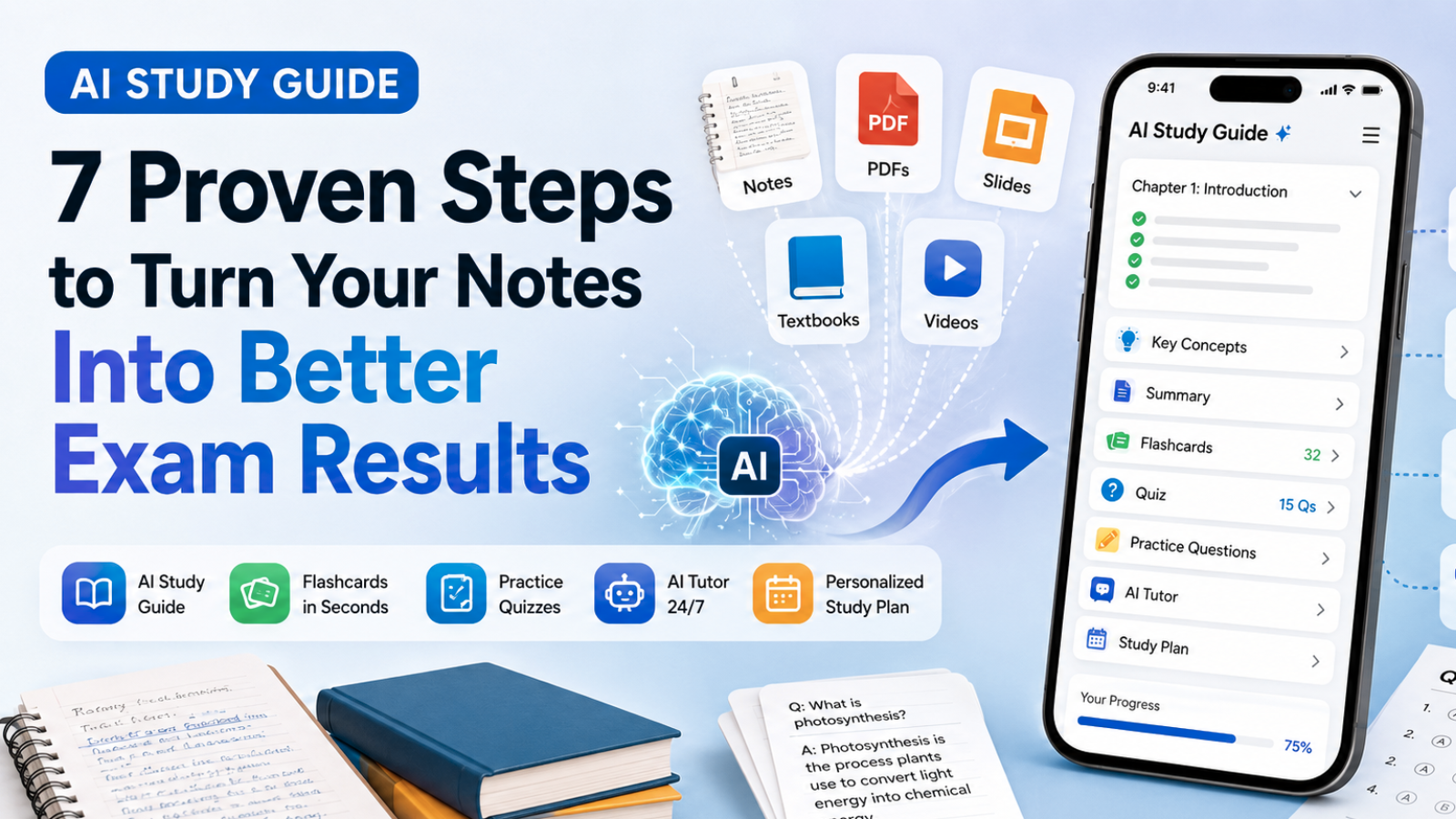
Creating a study guide is one of the most time-consuming parts of exam prep. You already have the notes, PDFs, slides, and textbooks, but turning them into something usable takes hours that most students do not have. That is where most students lose time.
AI turns your materials into a structured AI study guide in minutes. Instead of spending time organizing, you start actually learning. The best AI study tools do not just summarize notes. They build study plans, generate flashcards and quizzes, explain difficult topics, and guide your revision from start to finish.
In this blog, you will learn how to turn your notes into an AI study guide that actually helps you improve exam results, not just organize information.
Why Creating a Study Guide Takes Longer Than It Should
Most students do not struggle because they lack information, they struggle because everything is all over the place. By mid-semester, your materials are spread across lecture notes, slides, PDFs, textbooks, and random revision docs. None of them are structured for studying.
This creates two real problems.
1. You waste hours before you even start studying. You end up sorting, reorganizing, and deciding what matters instead of actually learning it.
2. You confuse organization with progress. Highlighting, rewriting, and cleaning notes feels productive, but it does not improve memory or exam performance.
A good study guide should help you start learning immediately, and that’s exactly what Kluvi does.
The Hidden Cost of “Productive Procrastination”
When exam season approaches, anxiety levels spike. To cope with this stress, the human brain naturally looks for low-resistance tasks that offer an immediate sense of accomplishment. This psychological trap is known as productive procrastination.
Color-coding your binders, rewriting clean definitions into a brand-new notebook, and neatly formatting headers are all classic examples. You feel like you are working hard because you are sitting at your desk handling course material. In reality, you are avoiding the difficult, high-effort cognitive tasks, like testing your memory or self-correcting mistakes, that actually build long-term retention.
By offloading the structural formatting to a dedicated digital tool, you bypass this entire trap. An automated AI study guide strips away the administrative filler and forces you to confront the actual material immediately, shifting your energy from passive preparation to active learning.
Can AI Create a Study Guide From Notes?
Yes, AI can now turn your notes into a structured study guide automatically.
Today, AI study tools can:
- Turn messy notes into structured topics
- Highlight what actually matters for exams
- Generate flashcards in seconds
- Create practice quizzes from your content
- Build a study plan based on your exam date
- Explain difficult concepts in simple steps
But the difference between tools is huge. Generic AI chatbots give you summaries, whereas study-focused AI tools turn those summaries into an actual learning system. That is where results change.
We explain this in more depth in our blog on the best AI study apps and how they actually work in practice.
The Illusion of Competence: Why Traditional Methods Fail
Before looking at how AI optimizes this workflow, we must address why conventional study methods fall short. Many students rely heavily on linear re-reading and passive highlighting. Cognitive scientists call the psychological trap these methods cause the illusion of competence.
When you read a clean, highlighted chapter over and over, your brain mistakes visual familiarity for conceptual mastery. Because your eyes glide easily across text you have seen before, you assume you will easily recall it during a high-stress test.
True memory consolidation requires cognitive friction. Your brain must work to retrieve information. Building a traditional study guide by hand can create that friction, but only if you spend hours synthesizing it yourself. Unfortunately, most students run out of time during the building phase, leaving zero room for execution. An AI study guide solves this bottleneck by taking over the layout and structuring mechanics, immediately putting you face-to-face with active practice.
What Can You Turn Into an AI Study Guide?
One of the biggest advantages of AI is that it works with the materials you already have. Instead of rewriting your notes from scratch, you can upload the resources you’ve collected throughout the semester and let AI organize them into one study guide.
This is where AI removes the need to think about structure entirely. Instead of you figuring out structure, AI builds it for you.
A good AI study guide does not just organize notes. It turns them into something you can actively study from:
- Clear learning sections instead of scattered notes
- Key concepts grouped by topic
- Removal of repetition and noise
- Short, focused explanations
- Built-in quizzes and flashcards for active recall
You go from “I have a lot of notes” to “I know exactly what to study today.” in just a few minutes.
7 Proven Steps to Turn Your Notes Into an AI Study Guide
Step 1: Gather All Your Study Materials
Start with everything you have.
Many students only upload lecture notes and forget about textbook chapters, assignment feedback, practice questions, or YouTube videos. These additional resources often contain important explanations and examples that improve the quality of your study guide. Spending a few minutes gathering everything at the beginning saves time later and gives AI a much better understanding of your course.
Step 2: Upload Everything Into One AI Study App
The best results come from using a single app instead of multiple tools.
When your notes, PDFs, textbook chapters, and lecture slides are uploaded together, AI can understand how topics connect across your entire course. This produces a study guide that follows the structure of what you actually learned instead of summarizing isolated documents.
If your app also supports handwritten notes and images, include those as well. Class notes often contain explanations and examples that don’t appear in the textbook.
You can do this easily with Kluvi.
Step 3: Let AI Organize Your Notes Into a Structured Study Guide
This is where AI saves the most time. Instead of figuring out structure yourself, AI builds it for you in seconds. A good AI study guide should:
- Group related concepts together
- Remove unnecessary repetition
- Create concise lesson plans
- Organize information into manageable sections
- Explain difficult concepts in a way that helps you actually learn
- Include active recall features like quizzes and flashcards so you can practice
Instead of facing hundreds of pages of scattered material, you now have a clear starting point for revision.
Step 4: Review and Refine Your AI Study Guide
AI can save hours of work, but the best results come from treating the study guide as a starting point rather than a finished document. Read through the generated lessons and compare them with your original materials. Add any examples your instructor emphasized during lectures, clarify topics that deserve more detail, and remove information that is not relevant to your exam.
This short review has another benefit. Revisiting your notes while making small adjustments helps reinforce what you have already learned. Instead of passively accepting AI-generated content, you begin engaging with the material before your first study session.
Step 5: Turn Your Study Guide Into Flashcards and Quizzes
Reading a study guide can help you understand a topic, but understanding and remembering are not the same thing.
Research in cognitive science consistently shows that active recall is one of the most effective ways to strengthen memory. Instead of repeatedly reading the same page, you challenge yourself to retrieve information without looking at the answer.
That is why the best AI study tools do more than summarize notes. They also generate flashcards and quizzes directly from your study guide.
Flashcards help you memorize key definitions, formulas, vocabulary, and concepts, while quizzes test whether you can apply what you have learned. Every question you answer correctly strengthens your memory, and every mistake highlights a topic that deserves another review.
By turning your study guide into active practice, you spend less time rereading and more time preparing for the type of thinking your exam requires.
Step 6: Use an AI Tutor to Understand Difficult Topics
Every student reaches a point where reading the same explanation over and over no longer helps.
Maybe a calculus problem still does not make sense, a chemistry equation refuses to balance, or a concept from biology simply refuses to stick. This is where an AI tutor becomes valuable.
Instead of searching through forums or waiting until the next class, you can ask questions the moment you get stuck. A good AI tutor explains concepts in different ways, walks through problems step by step, and helps you understand why an answer is correct instead of simply giving it to you. Learning becomes much more effective when you receive feedback immediately. Small misunderstandings are corrected before they turn into larger gaps in your knowledge.
Step 7: Follow a Personalized Study Plan
A study guide is only useful if you actually use it.
One of the biggest mistakes students make is spending hours creating study resources without planning when they will review them. As exams get closer, the workload grows and cramming becomes almost unavoidable.
A personalized study plan solves this problem by breaking revision into manageable daily sessions. Instead of asking yourself what to study every evening, you already know which topics deserve your attention and how much progress you should make before your exam. Consistency almost always produces better results than trying to learn everything in a single weekend.
What Makes an AI Study Guide Effective?
Not every AI study guide delivers the same value. Some tools simply shorten your notes into a few paragraphs. While summaries are useful, they rarely prepare you for an exam on their own. An effective AI study guide should help you move through every stage of learning.
Look for an app that can:
- Create concise lessons from your own materials
- Generate flashcards automatically
- Build quizzes based on your coursework
- Explain difficult concepts with an AI tutor
- Create a personalized study plan
- Track your progress over time
These features work together to create an active learning experience instead of a document that you read once and forget.
How Kluvi Goes Beyond a Traditional Study Guide
Most software stops at basic summaries or simple flashcard creation, but Kluvi is built to take you all the way to absolute exam readiness. You upload your lecture notes, PDFs, slides, images, or audio files, and Kluvi turns everything into a fully structured, reactive study system tailored to your exact exam date and performance goals.
Instead of a static document, you get a comprehensive and dynamic AI study plan:
- A personalized study plan that tells you exactly what to review each day
- AI-generated flashcards built straight from your specific class materials
- Practice quizzes that test real exam-level logic and knowledge applications
- Step-by-step breakdowns for complex equations and difficult topics
- Targeted practice exercises designed to reinforce specific weak points
- Podcast-style lessons optimized for passive listening during your daily commute
- An interactive AI tutor you can message anytime you need clarification
- Granular progress tracking so you know what you have actually mastered
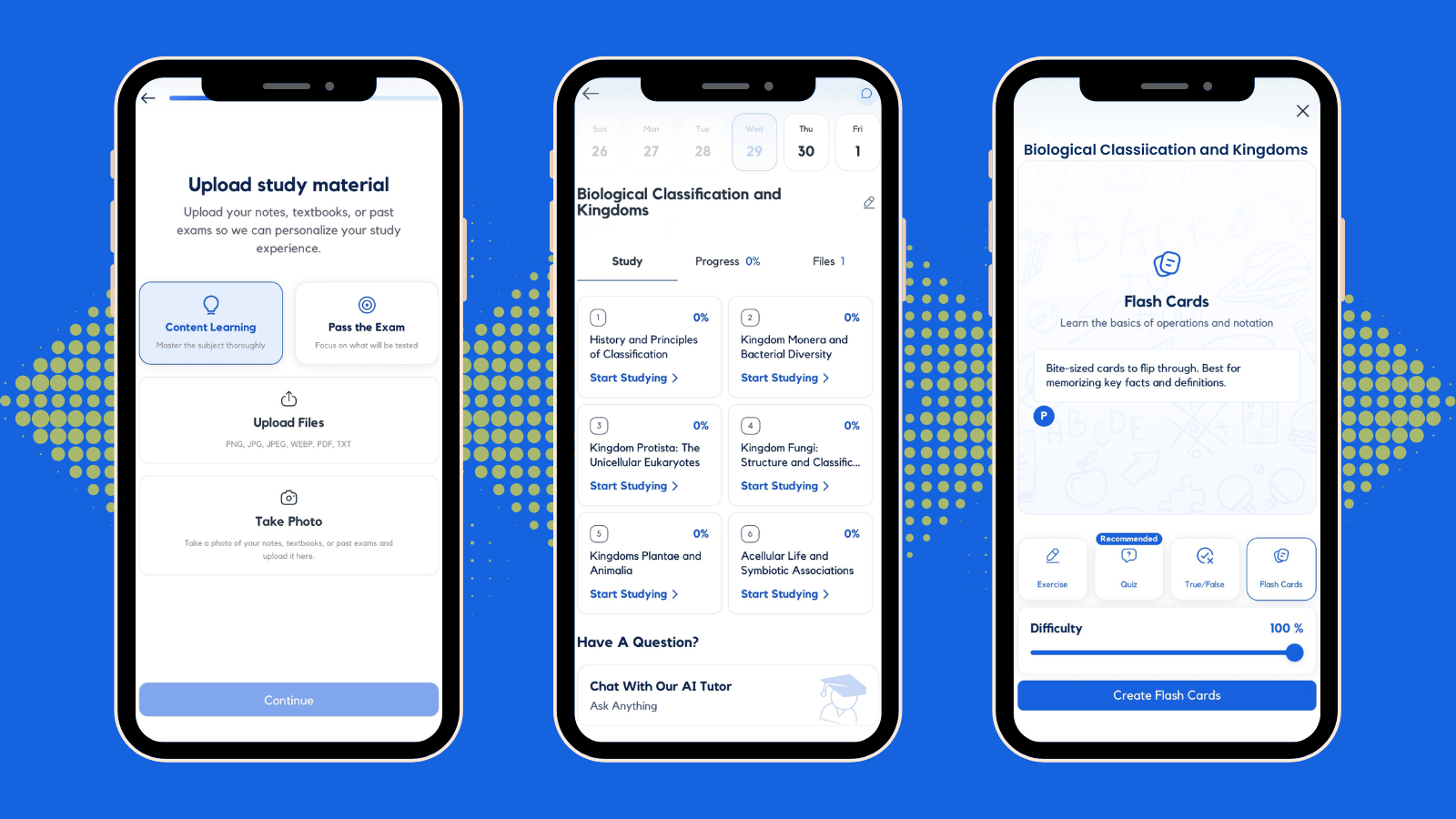
Study Plan Optimization
Everything is built entirely from your course material, not generic online question banks. So instead of spending hours organizing and guessing what might be on the test, you spend your time actually improving your core understanding and driving up your final exam scores with a tailored AI study guide.
Common Mistakes to Avoid When Using AI Study Guides
AI can make studying more efficient, but it cannot replace good study habits. Students often get the best results when they avoid these three common pitfalls:
Uploading incomplete materials
If you only upload one chapter summary or a few scattered pages of scratchpad notes, your AI study guide will have systematic blind spots. Include as much contextual course material as possible, the more comprehensive the input data, the more accurate and helpful the output study materials will be.
Reading instead of practicing
Summaries are perfect for initial baseline understanding, but they should quickly lead into active execution. Spend at least 70% of your total study time actually answering practice questions, tackling AI quizzes, reviewing flashcards, and explaining concepts back to the AI tutor within your system.
Waiting until the night before the exam
AI can organize your scattered materials in a matter of minutes, but meaningful neuroplasticity and memory retention still require temporal spacing. Creating your AI study guide early in the semester gives you a wide window to consistently review difficult topics and iron out misunderstandings.
Comparison: Traditional Manual Prep vs. AI-Driven Exam Prep
| Feature | Traditional Manual Study Prep | AI-Driven Study Prep |
| Setup Time | 5–10 hours per exam module | 2–5 minutes via document upload |
| Study Format | Linear outlines and handwritten lists | Interactive flashcards, quizzes, & audio |
| Error Handling | Checking textbook indices manually | Instant step-by-step AI tutor explanations |
| Schedule Structure | Self-made calendars (often abandoned) | Dynamically updating automated daily plan |
| Learning Style | Heavily passive (re-reading, highlighting) | Heavily active (active recall, adaptive intervals) |
Frequently Asked Questions
Can Kluvi create a study guide from handwritten notes?
Yes, Kluvi can analyze handwritten notes, PDFs, and images before turning them into structured AI study guide.
Can Kluvi generate flashcards from my notes?
Yes, Kluvi automatically create flashcards from lecture notes, PDFs, textbook chapters, and other uploaded materials.
Is an AI study guide enough to prepare for an exam?
A study guide is an excellent starting point, but students usually achieve better results when they combine summaries with flashcards, quizzes, practice questions, and regular review.
How does the AI tutor handle math equations?
Unlike standard text models, study-focused AI engines break complex formulas down into logical micro-steps. You can ask the tutor to isolate a single step of a problem, explain the mathematical property behind it, or provide an analogous problem to test your understanding.
What is the best AI study guide maker?
The best AI study tools do much more than summarize notes. Look for an app that also creates personalized study plans, generates flashcards and quizzes, provides AI tutoring, and helps you track your progress throughout the semester. You can check out Kluvi.
Turn Your Notes Into a Complete Study System
Creating a study guide should help you start learning sooner, not delay the process.
AI makes it possible to organize your notes, identify important concepts, and generate personalized study resources within minutes. When those resources are combined with active recall, guided practice, and a structured study plan, preparing for exams becomes more organized and significantly more effective.
Kluvi turns your notes into a complete study system in minutes, so you can focus on understanding, practicing, and improving your exam results.
A good study guide helps you organize information. A great study system helps you remember it. Kluvi combines personalized study guides, flashcards, quizzes, AI tutoring, and structured study plans so you can spend less time organizing your notes and more time preparing for your exams.
Download Kluvi on iOS or Android and and turn your notes into a complete AI study guide in minutes.